
Tankersley, Hoyland, Birdwell, Elsecar and Wombwell all grew up around coal and iron, and that history is still visible in the streets: long terraces built for miners, estates that followed, and the stone cottages of a village laid out by a great landowner. The weather is hill-country weather, and the windows show it. Each of the five collects its own kind of dirt, from the grey film of the A61 and the M1 to green algae on shaded stone. What follows covers how we work in each place, what different types of street ask of the job, and how often a Barnsley home needs the glass done.
What marks Barnsley glass
Hoyland takes its name from an Old Norse word for land on a hill spur, and it stands up to its name. Exposed ground catches wind and rain at an angle, and the glass that faces the weather collects a gritty film that dries in streaks. Fine dust blows in from open land and from the reclaimed sites left by the collieries, and settles on any window that faces it.
Lower down, where valleys hold damp air, algae creeps into frame corners and along the edges of seals. Trees in gardens and on old industrial land drop blossom, sap and seed, and the A61, the M1 and the Dearne Valley Parkway add a grey layer of traffic film. Barnsley glass seldom gets dirty in just one way, which is why a method that leaves nothing behind matters so much.
The Barnsley homes we clean
Mining shaped the housing. Colliery terraces run in long, tight rows in Hoyland and Wombwell, and later council and private estates spread across the open ground between. Hoyland still has some late Georgian houses and older cottages among the later building, Birdwell lines its main road with terraces and semis, and Tankersley is a small village of older stone houses and newer homes among fields. Newer estates and bungalows fill in the edges of all of them.
Elsecar is a different story, a village planned from the 1790s for the ironworks and collieries of the Wentworth Woodhouse estate, with rows of miners' and ironworkers' cottages, a village green and heritage buildings. Many properties there are listed or in a conservation area. Whatever the street, we choose the method to suit the glass: the pole for most windows, squeegee and ladder where a pane is small, detailed or awkward.
Tankersley and Birdwell
Tankersley sits just west of junction 36 of the M1, north of the A61, a small village around St Peter's church, parts of which date from the 14th century. Its homes are spread among fields and plantations, so glass collects pollen and dust off the farmland in spring and summer and wind-blown leaves in autumn, while houses nearest the motorway pick up a fine grey road film.
Birdwell is strung along the A61 Sheffield Road between Hoyland Common and Worsbrough, with the roundabout at junction 36 and the start of the Dearne Valley Parkway at its southern end, near the obelisk of 1775. Terraces and semis face straight onto that road, and traffic film is the main job on their front windows. Behind the main road, quieter estates and homes near the small woods are cleaner but catch sap and blossom.
Hoyland
Hoyland is a town of terraces, estates and commons strung along high ground. Hoyland Common and Platts Common, which only took shape as settlements after the enclosure Acts of the 1790s, began with small homes for miners and nail-makers and have since filled with council and private housing. The old centre has Market Street and West Street, the town hall, which has apartments in its upper floors, and churches built in sandstone and brick.
Streets here are exposed, and the windows show it. Rows of identical terraces and estate semis mean the same job repeated house after house, which suits the pole: we move down the street one frontage at a time. On the weather side, frames and sills gather grit and moss spores, and doors and porches get the same treatment as the windows. Hoyland North, a large area of newer building, adds modern windows with deep reveals that hold dust.
Elsecar
Elsecar sits in a valley below Hoyland, built from the 1790s by the fourth Earl Fitzwilliam as an estate village for the ironworks and collieries. Rows of cottages, an old green, a heritage centre in the former workshops and a famous Newcomen engine give it a character found almost nowhere else in the borough, and much of it is in a conservation area.
That matters for window cleaning in a practical way. Windows in older stone cottages can be small, deeply set and old, and the stone around them is not ours to touch, so we clean glass, frames and sills only, with gentle methods. If your house is listed or in the conservation area, tell us when you enquire. Pure water and a soft brush change nothing about the building, and hand work takes care of the small panes. The valley is damp, and green algae is the usual culprit.
Wombwell
Wombwell is the largest of the five, a Dearne valley town that grew around the Wombwell Main and Mitchells Main collieries. Terraced streets run off the High Street and Station Road near the centre, close to the Old Town Hall of 1897 and St Mary's church, and large post-war estates and newer developments fill the outskirts. There is a lot of glass here, and a lot of it is on the same few designs.
Valley air keeps frames damp, so algae in corners and along seals is common, and homes on the busier roads collect traffic film. Newer houses on the edge of town often have big rear patio doors and conservatories that are worth adding to the visit. On terraced streets we work from the footway, keeping clear of parked cars and passers-by.
Newer windows and deep reveals
The newest estates around Hoyland and Wombwell have modern frames set deep into thick walls, and the reveals beside and above the glass trap dust and cobwebs that the rain never reaches. A window can look clean across the middle and grubby around the edges, which is why we brush the frame and the return as well as the pane.
Trickle vents, ledges and cills are another small trap. Dirt that settles there washes down over the glass the next time it rains, so clearing it at the source helps the clean last. It takes a few extra seconds a window and makes a visible difference by the following week.
How a window clean runs here
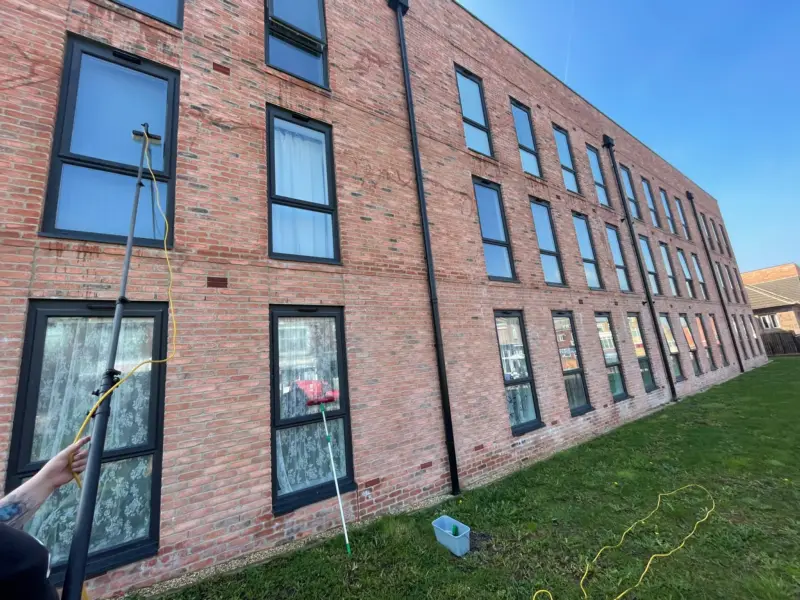
Each job starts with a look at how the property is laid out and a plan for getting round it. The pole carries a soft brush and a feed of purified water, and each window is worked through in turn, with glass, frame and sill brushed as one before a final rinse. With every mineral filtered out, the water dries without a trace, so the windows finish on their own and nothing is wiped on afterwards.
A tiny, leaded or awkward pane is better done by hand, and we say in advance which windows that applies to. Doors, porches and conservatory glass can be added to the visit. Hillsides need more thought than flat streets: a drive that rises, a garden that falls away behind the house or a path with steps can all change where we stand. Because all the work is outdoors, nobody has to be in, as long as gates, parking and access have been agreed.
The year on Barnsley windows
Spring brings pollen and a first look at what the winter did. Summer is dust and insects, and the long days make visits easy. Autumn adds leaf fall and low sun that shows every smear, and winter brings short days, frost and wind off the hills, so we work only when it is safe and rebook after storms.
For most homes the sweet spot is a visit about once every month or two. Exposed streets in Hoyland and Tankersley and houses on the A61 through Birdwell lean towards the monthly end. We offer a rhythm at the quote and tune it once we see how fast your own glass dirties.
Common window problems in Barnsley
These are the faults we meet most often across the five places we cover:
- A gritty grey film on the glass and frames of houses on exposed ground
- Traffic film on windows facing the A61, the Dearne Valley Parkway and other main roads
- Algae furring the corners of frames and seals on damp, shaded and stone-built homes
- Pollen, sap and blossom on windows near trees, fields and old industrial land
- Dust in the deep reveals of newer windows
- Tap-water spots on glass cleaned by hose or cloth
Window cleaning with other jobs in Barnsley
Plenty of Barnsley homes get the entire exterior freshened in a single trip. Gutter cleaning in Barnsley stops overflow streaking clean glass, soffit and fascia cleaning lifts the roofline, and conservatory cleaning covers the glazed extension. Traders and landlords have commercial window cleaning to look at.
The same windows service runs in Sheffield and Rotherham, and you can see the lot under exterior cleaning in Barnsley.
Still reading? There is more.
8 more sections cover: