
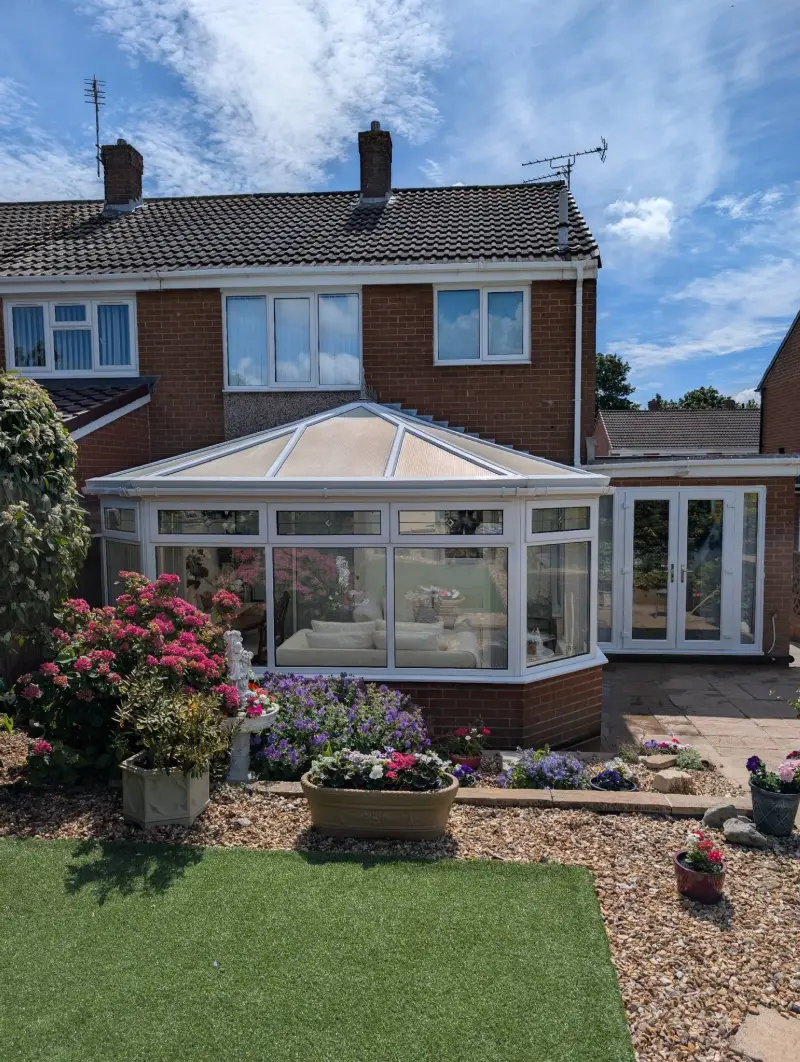
Gardens south of Barnsley are not kind to glass. Many sit on high, open ground at Hoyland and Tankersley where the wind drives grit over the lawn, others are shaded by trees or boxed in by fences, and the damp of the Dearne valley at Wombwell keeps everything wet longer than it should. A conservatory is meant to be the brightest room in the house, yet its roof is nearly flat, its seals hold moisture and its frames catch dirt in every groove. Below we describe what builds up on a conservatory in each of the five places we cover, how we deal with it from the ground, and how often a visit pays off.
Why Barnsley conservatories lose their light
A roof with hardly any pitch cannot shed what lands on it. Rain lies in the bars and along the edges, carrying dust and plant debris into the joints, where it dries and sets. Shade from a fence, gable or tree extends the damp, and algae and moss take full advantage, spreading across the panels as a green wash and packing every gap.
The wind matters more here than in most places. On exposed plots it lifts grit and seed and drops them on the nearest flat surface, and a conservatory roof is flatter than anything else in the garden. Birds sit on it too, and what they leave bakes hard in the sun. By the time the room feels gloomy from inside, the outside has usually gone unwashed for years.
The designs we meet across Barnsley
Estates and bungalows tend to have the simpler shapes: a lean-to against the back wall, or a modest Victorian-style room with a faceted roof. Larger houses carry gable-fronted versions with longer roof runs, and the occasional orangery pairs solid roof sections with a glass lantern. All have valleys where water and debris collect, and joints that can harbour growth.
Roofs are glass, polycarbonate or a mixture, and some glass has a self-cleaning coating. Glass is tough but shows every smear from indoors, while polycarbonate scratches if it is scrubbed hard. Style, material and access all alter how a visit is planned, so we look at them before we quote.
Conservatories in Tankersley and Birdwell
Tankersley's homes look out over fields and plantations, and conservatories on the open side of the village take wind-blown seed, pollen and dried grass in summer and leaves in autumn. The newer houses tend to have modern designs with polycarbonate or glass roofs, and older stone properties sometimes have a lean-to against a gable wall, where the join between stone and frame gathers grime.
In Birdwell, conservatories sit behind the terraces and semis that line the A61 and on the estates beyond, many backing onto farmland or the small woods nearby. Roofs nearest the main road carry a grey road film, and those beside the trees collect sap and leaves. The village's gardens are mostly level and open, so the pole reaches the whole roof without fuss.
Conservatories in Hoyland
Hoyland's estates and commons are prime conservatory country: post-war semis and bungalows with back gardens made for a glazed extension. The land is high and open, on a hill spur topped by the old Lowe Stand folly, and wind sweeps over the fences with grit, leaves and seed. Roofs here collect the dust of nearby fields and the leftovers of neighbouring gardens.
Moss from concrete-tiled house roofs often washes into the conservatory's own small gutter, and trees in the surrounding gardens add blossom and sap. A conservatory on the weather side of a house can take a pounding from driven rain, which leaves long streaks. Spring and autumn visits are the common pattern, and we plan around the garden's shape.
Glazed extensions in Elsecar
Elsecar's cottages and estate buildings are older and often protected, so full-sized conservatories are uncommon. Glazed porches, small lean-tos and sensitive rear extensions do exist, usually tucked behind the main building, and they share the village's damp valley air, with trees by the canal and the park keeping them in shade.
Frames there green up fast and the small roof gutters fill with leaves. When a glazed extension is attached to a listed building, mention it in your first message. Cleaning from the ground leaves the structure untouched, but knowing the setting helps us plan the visit.
Conservatories in Wombwell
Wombwell has more conservatories than any other place we cover around Barnsley, on its big post-war estates and the newer developments around the town. Semis and bungalows with long back gardens carry lean-tos and Victorian-style rooms, and newer detached homes have larger designs, sometimes with a lantern roof over an extension.
The Dearne valley keeps the air damp, so algae spreads across roof panels and along seals faster than on the hilltops, and gardens with fences on both sides keep the lower part of the roof in shade. Terraced houses near the centre have smaller glazed porches and kitchen extensions at the back, which we reach from the yard or the garden.
Working from the ground
The kit is a reach pole fed with purified water and tipped with soft brushes, and whoever is holding it stays on the grass or the patio. Moss, algae and droppings are lifted off the roof sheets and bars, then the glazing at the sides, the frames and the seals get their turn, and a last rinse dries without a trace.
Before the visit we choose where to stand, ideally level lawn or patio with a clear view of each facet. We then circle the structure as we work. We note the scope with you in advance: roof, side glass, frames, small gutters. If we notice a loose cap, a cracked panel or a unit that has misted inside, you hear about it at the end.
Wind, grit and open plots
Much of this side of Barnsley stands on open ground with little to break the wind, and that shapes the kind of dirt a conservatory collects. Fine grit from roads and fields, seeds, grass and blown leaves land on the roof and stick wherever water has lingered, and a gale can leave a visible film in a single afternoon.
Hedges and fences help, but they also create the shade and the corners where debris collects. Where we can see the wind is the main cause, we say so, because it changes what is realistic: a plot in the open will need more regular attention than a sheltered one.
Seals, frames and the small parts
A conservatory is more than a roof. Each frame has grooves, every pane has a seal, and the bars between the roof sheets carry a surprising amount of grime in their channels. Doing them alongside the glass keeps the green from creeping back in from the edges, and the whole building ends up looking of a piece.
It is also the best chance to see how the building is ageing. Lifting seals, loose caps and frames starting to discolour all stand out on a clean roof and vanish under a green one.
Glass, polycarbonate and coatings
Soft bristles and pure water suit either roofing material. For glass the point is a generous rinse, since a film is obvious from inside, and for polycarbonate it is a light hand with nothing abrasive. Detergent is never needed.
A self-cleaning coating is something to treat gently, because strong cleaners can spoil it. If your roof has one, say so up front and pass on whatever the maker advises.
Through the seasons
Spring dusts the roof with pollen and blossom, and the first bright mornings show what the winter left. Summer bakes droppings onto the glass and exaggerates every mark. Autumn fills the valleys and gutters with leaves, and winter damp lets algae spread while the room sits unused.
A spring clean to prepare for summer, and a second after the leaves have fallen, suits many households. Shaded, tree-covered roofs in Elsecar or Birdwell may need more, and open sunny ones in Hoyland can manage with less.
What a Barnsley conservatory visit deals with
From Tankersley to Wombwell, a visit usually takes in some of the following:
- A green wash of algae and moss in the roof bars and along the lower edge
- Droppings baked onto the roof beneath perches
- Grimy frames and seals with growth in the corners
- Leaf mould and silt clogging the narrow roof-edge channel
- Pollen, sap and grit that dull the glass
- A sealed unit that has misted, which cleaning cannot cure but a clean roof exposes
Pairing a conservatory with other work
Conservatory gutters clog almost at once, which makes gutter cleaning in Barnsley the obvious companion. Roof cleaning sees to the house roof overhead, and window cleaning brings the other glazing into line.
Conservatories are also cleaned in Sheffield and Rotherham, and the whole range sits under exterior cleaning in Barnsley.
Still reading? There is more.
10 more sections cover:
- Conservatories in Hoyland
- Glazed extensions in Elsecar
- Conservatories in Wombwell
- Working from the ground
- Wind, grit and open plots
- Seals, frames and the small parts
- Glass, polycarbonate and coatings
- Through the seasons
- What a Barnsley conservatory visit deals with
- Pairing a conservatory with other work