
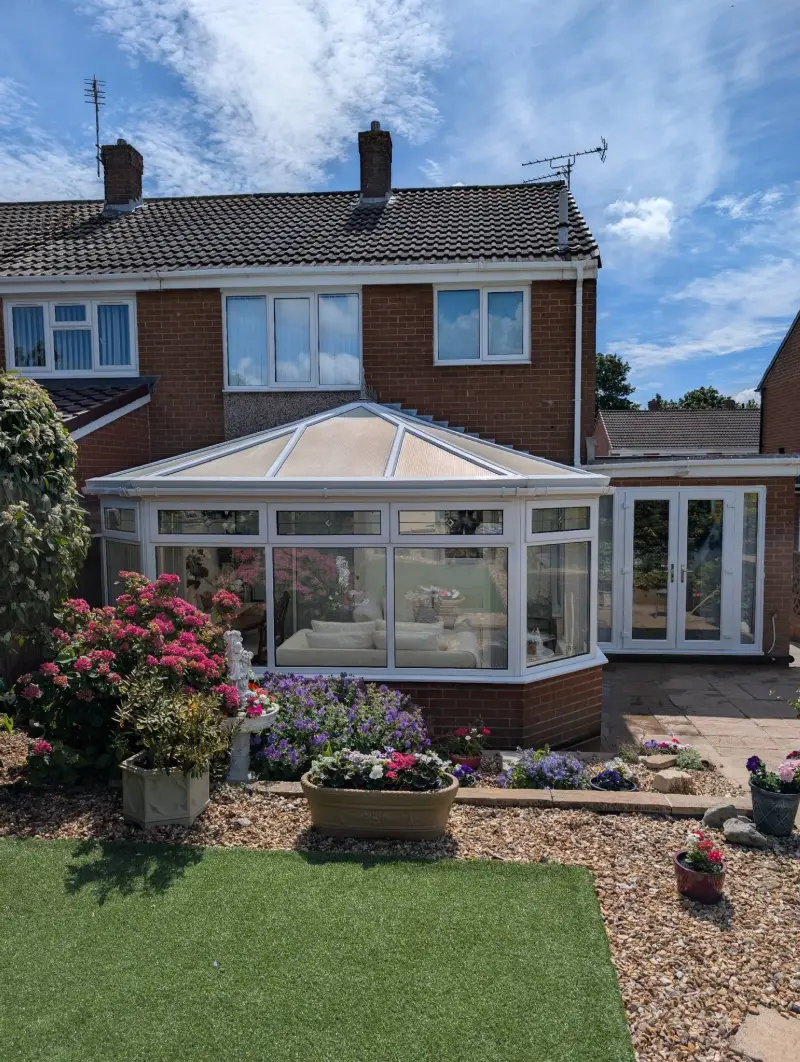
A conservatory should be the brightest room in the house. Over time the roof, glass and frames collect moss, algae and bird mess, the light turns green and dull, and the room becomes somewhere you avoid. This guide explains why conservatories get so dirty, how professional conservatory cleaning works, what to expect from it, and how to keep your conservatory bright all year.
Why conservatories get so dirty
A conservatory is made almost entirely of glass or panels, with frames and seals between them, and every one of those surfaces is exposed to the weather. The roof sits at a shallow angle, so rain does not run off quickly. Water, leaves and dirt gather in the joints and along the edges, and stay damp for long periods.
That is the ideal environment for algae and moss. Many conservatories also sit beneath trees, next to fences or at the back of a house where the light is limited, which makes things worse. Birds like to perch on conservatory roofs, and their droppings dry hard on the surface.
What a dirty conservatory costs you
The most obvious effect is the light. Green algae, moss and grime on the roof and glass cut down the daylight coming through, so the room feels darker and less pleasant, even on a bright day. The view out is dulled, and the room often looks tired from the garden as well.
Dirt and growth can also harm the structure over time. Moss and algae hold moisture against seals and frame edges, and a roof that cannot shed water properly puts more strain on joints and gutters. A clean conservatory is easier to maintain and easier to spot problems on, such as a failed seal or a cracked panel.
Signs your conservatory needs cleaning
Most of the signs are easy to see from inside the room as well as outside:
- A green, grey or brown tinge to the roof panels or glass, especially when you look up from inside
- Moss gathering along the roof bars, the ridge and the edges of the roof
- Black or green marks in the frame corners and along the seals
- Bird droppings on the roof or on the window ledges
- Leaves, seeds and debris collected in the roof gutters
- A room that feels noticeably darker than it did when it was first built
How we clean a conservatory
Conservatory roofs are easy to damage and unsafe to stand on, so we do not try to. We use a water-fed pole with soft brushes and purified water, which lets us reach the whole roof from the ground.
- We look at the conservatory with you and agree what is included, such as the roof, glass, frames and gutters
- Soft brushes loosen moss, algae and bird mess from the roof panels and the roof bars
- Glass, frames and seals are brushed and rinsed, so the clean extends to the green film that gathers in the joints
- Purified water rinses everything away and dries clear, leaving no streaks or spots to spoil the view
- We check the roof edge and gutters as we go and let you know about anything that needs attention
Glass roofs, polycarbonate roofs and self-cleaning glass
Conservatory roofs are usually either glass or polycarbonate, and soft brushes with pure water are suitable for both. Polycarbonate can scratch if it is scrubbed with something coarse, so a gentle approach matters. Glass roofs reward a thorough rinse, because any film left on them shows up clearly from inside.
If your conservatory has self-cleaning or coated glass, please tell us when you ask for a quote. Coatings are designed to react with daylight and rain, and they should be cleaned without detergents or abrasives. Pure water and soft brushes are a good match, but it is sensible to mention any special coating or warranty first.
Lean-to, Victorian, Edwardian and orangery styles
Conservatories come in a few standard shapes, and each one collects dirt in its own way. A lean-to has a single sloping roof, which is simple to reach but often sits in the shade of the house wall. A Victorian or Edwardian conservatory has a faceted, pitched roof with a ridge and valleys between the facets, and those valleys hold water, leaves and moss. Gable-fronted designs have long roof runs that need working across carefully.
Orangeries and lantern-roof extensions are part solid roof and part glass. The solid sections can grow moss and algae like any other roof, while the glass lantern in the middle needs the same careful brushing as a conservatory roof. We look at the shape of your roof before we quote, so the method and the time we allow suit what is actually there.
What affects how your conservatory turns out
These are the main things that make a difference to the job and the result:
- The size and shape of the roof, including lean-to, Victorian and gable styles
- How long since the last clean, and how thick the moss and algae are
- Trees and fences nearby, which keep the roof damp and drop debris on it
- Access to the sides and back of the conservatory, which affects how we reach the roof
- The condition of the seals and frames. Cleaning removes the growth but cannot repair worn seals
What we look for while we clean
Brushing every panel, bar and seal means we see the whole roof close up, and we tell you about anything we notice. That might be moss packed into the roof valleys, a gutter that has come loose or is full, green marks at the base of the frames, a panel that looks cracked or discoloured, or a seal that has started to peel. Some of these are simple to put right, and others are worth asking a conservatory specialist about. Either way, we will tell you plainly what we saw and where, so you can decide what to do about it.
A misted sealed unit, where condensation has appeared between two panes of glass, is a good example of something cleaning cannot fix but which is much easier to spot once the glass is clean.
How often should a conservatory be cleaned?
Many customers have their conservatory cleaned once or twice a year, often in spring and autumn. Conservatories under trees, or in damp, shaded spots, benefit from more frequent attention, while those in open, sunny positions can stay clean for longer.
We are happy to suggest a timetable that suits your conservatory, and it often works well alongside your regular window cleaning.
A year in the life of a conservatory roof
Conservatories feel the seasons more than most rooms. Spring brings pollen and blossom that settle on damp panels, and the first warm days show up every smear and green patch because so much light is coming through. In summer the sun bakes bird droppings and dust onto the roof, and a dirty roof is at its most obvious from inside on a bright day.
Autumn fills roof gutters and valleys with leaves, and wet debris left there feeds algae and moss through winter. Winter is the dampest time, so growth gets going on shaded panels even though the room is little used. That is why many people clean in spring, to get ready for the sunny months, and again in autumn after the leaves have fallen.
Can you clean it yourself?
You can clean the glass at ground level and the inside of the frames yourself, and regular wiping helps. The roof is the difficulty. It is hard to reach safely, and standing or leaning on it risks damaging panels and causing serious injury.
Household cleaners can also leave a film that attracts dirt, and strong chemicals can harm seals and frames. A pole with pure water avoids all of that.
Making the most of your visit
A conservatory visit often goes hand in hand with other exterior jobs. Gutter cleaning is a good addition, because conservatory gutters fill with moss and debris quickly. Window cleaning covers the rest of the house, and roof cleaning deals with the main roof above and around the conservatory.
We clean conservatories across Sheffield (High Green, Chapeltown, Burncross, Ecclesfield, Grenoside, Wincobank, Stannington, Oughtibridge and Hillsborough), Rotherham (Thorpe Hesley, Kimberworth, Greasbrough, Brinsworth, Wickersley, Scholes and North and South Anston) and Barnsley (Tankersley, Hoyland, Birdwell, Elsecar and Wombwell). Choose your town below to see how we handle conservatory cleaning where you live, or send us your address and we will confirm we cover it.
Still reading? There is more.
9 more sections cover:
- How we clean a conservatory
- Glass roofs, polycarbonate roofs and self-cleaning glass
- Lean-to, Victorian, Edwardian and orangery styles
- What affects how your conservatory turns out
- What we look for while we clean
- How often should a conservatory be cleaned?
- A year in the life of a conservatory roof
- Can you clean it yourself?
- Making the most of your visit