
A commercial frontage is judged in seconds by customers walking past, and in north Sheffield many of those frontages sit on routes carrying heavy traffic, which deposits film on glass faster than most owners expect. Managing glazing here means planning around pavements, parking, tram lines, steep approaches and tight trading hours. This guide sets out how a commercial window cleaning contract works from High Green and Chapeltown to Wincobank and Hillsborough, what each centre presents, how access and working at height are handled, and how a schedule is built around your premises.
Commercial glazing in north Sheffield: the setting
Commercial premises here tend to sit on busy corridors. Penistone Road, Halifax Road, Langsett Road and Middlewood Road carry heavy traffic through retail and mixed-use frontages on the north-west side, and the A6135 runs through the centres of Ecclesfield and Chapeltown. Exhaust film, brake dust and road spray reach glazing at street level quickly, and rain on an exposed frontage dries in streaks.
Topography shapes the work as much as traffic does. Many frontages are on sloping streets with pavements at an angle, narrow footways and steps at doorways, and buildings that step down a hillside have glazing at different heights along one elevation. We assess each site for these conditions before we quote, and plan equipment, positions and pedestrian management accordingly.
Premises we clean: retail, offices, schools and civic buildings
Retail units range from shopfronts on suburban parades to units in village centres, with large display glazing that depends on clarity. Offices and workshop buildings, including those on the industrial estate at Thorncliffe, tend to have mixed glazing at ground and first floor level. Schools, churches, surgeries, community centres and libraries bring older, more detailed glazing, and a visitor profile that calls for careful planning.
Specification follows the building. Large shopfront panes suit a pole system and a pure-water rinse. Smaller or heavily detailed panes, such as the leaded and multi-paned windows common on older civic and community buildings, may suit squeegee and ladder work. Scope, frequency and access are agreed in writing with you before the first visit.
Chapeltown town centre, Thorncliffe, High Green and Burncross
Chapeltown is the commercial centre of the northern edge of the city: a town centre with shops, banks, cafes and services, a railway station and a park, on the A6135 between Sheffield and Barnsley. Close by is the Thorncliffe industrial estate, on the site of the former Newton Chambers works, where offices and units carry regular glazing at office level that suits the pole system. Vehicle access, parking and loading restrictions on the estate are agreed in advance.
High Green has a small village centre of shops and community premises, and Burncross, chiefly residential, has schools, surgeries, places of worship and a handful of local businesses. These buildings are typically one or two storeys with mixed glazing, and they are best served on a combined route with the Chapeltown frontages, which keeps travel time down and lets the visits run to a fixed pattern.
Village centres in Ecclesfield and Grenoside
Ecclesfield's centre combines shops, pubs, a library and schools with the historic church at its core, and it sits close to junction 35 of the M1, so frontages on the main road take a steady deposit of traffic film. Grenoside has a stone-built village centre with a small number of shops, pubs and community buildings, and premises on higher ground there face more wind and weather.
Many of these premises occupy older stone properties with smaller panes, timber or period frames and deep reveals. Those suit hand work with squeegee and ladder, where a pole would not achieve the finish a frontage needs. Newer business premises and school buildings, with larger regular glazing, are handled with the pole system and purified water.
Shops, schools and community buildings in Wincobank
Wincobank is mainly residential, but its local shops, schools, churches and community buildings need regular attention, and the area sits immediately above the commercial corridor of the lower Don valley around Meadowhall. Premises facing the valley take airborne dust from the roads and industry below, which dries on glass as a dull grey film rather than obvious dirt.
Frontages on the steep roads up the hill need careful positioning of equipment and attention to footing, and school and community sites need visits timed around their users. We agree access, timing and any temporary barriers with the premises manager so that cleaning is unobtrusive.
Hillsborough Corner, Stannington and Oughtibridge
Hillsborough Corner, where Langsett Road, Middlewood Road, Holme Lane and Bradfield Road meet, is one of the busiest retail and transport nodes in the north-west of the city, with shop-fronted terraces, a library, the park and a tram and bus interchange. Frontages beside tram lines and bus stops need disciplined pedestrian management and timing, and shopfronts on steep side streets mean uneven pavements. We schedule around peak footfall and match days.
Stannington and Oughtibridge have village centres with independent shops, cafes, pubs and community premises, many in older buildings with traditional glazing. Oughtibridge lies on the A6102 in the Don valley, where damp air and road spray leave frames grimy, and Stannington's premises stand on an exposed ridge. Both are served on planned routes with weather contingency, because wind can make work at height unsafe.
Site review and scope for Sheffield premises
Every contract starts with a review of the site, either in person or from the details and photographs you send. We record the glazing by elevation and level, the frame type, how each area is reached, and any restrictions: pavement width, tram or bus operations, locked yards, canopies, planters and parking. From that we propose a scope, a frequency and visit times, in writing.
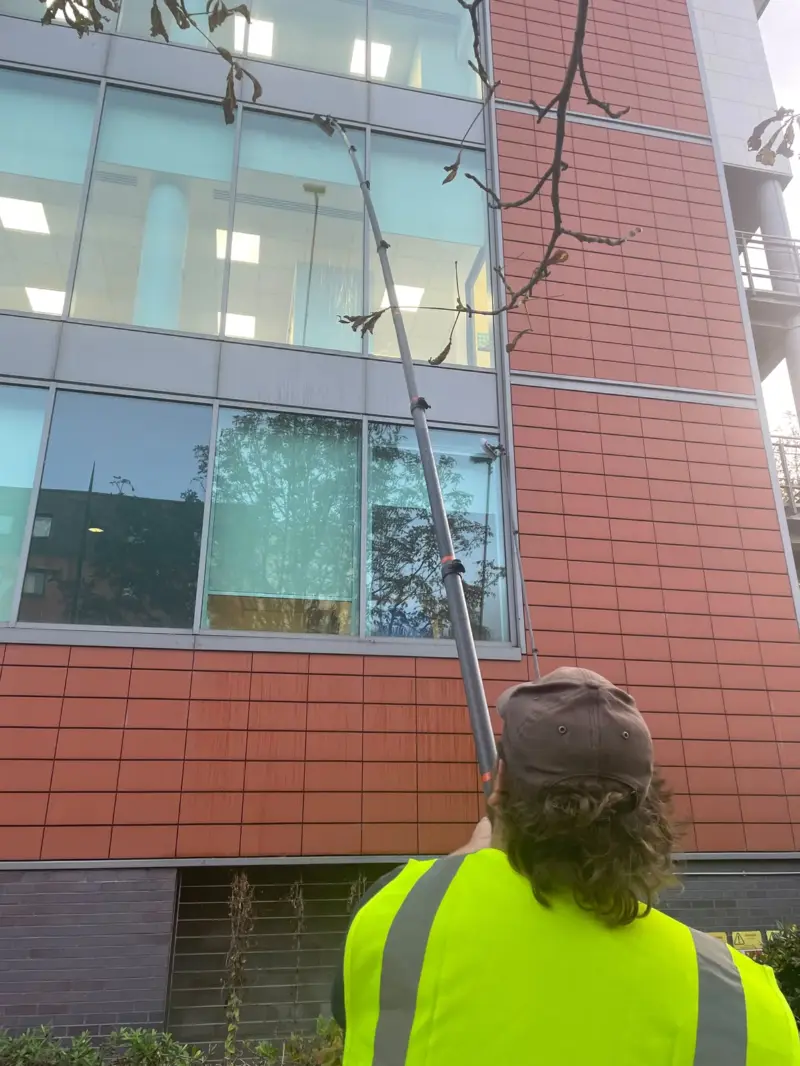
The methods are matched to the glazing. Pole systems with purified water suit shopfronts, curtain walling and frames at reachable heights, and where access is difficult or the glazing is detailed, squeegee and ladder techniques are used. The aim is the right method for each element, not a single approach applied everywhere. If anything about the site needs a closer look, we say so before we commit to a schedule.
Entrances, kerbs and the detail around the glass
The glazing that visitors touch and see up close sets the standard for the rest. Entrance doors, side panels, push plates and low-level glass collect fingerprints, spray from passing traffic and the grit thrown up by wheels, and on a Sheffield frontage that has been standing in rain and road salt, thresholds, door tracks and ledges collect it too.
We treat the frame and the surround as part of the glass. A bright pane in a grey frame, or above a dirty sill, still looks neglected from the pavement. Brushing and rinsing the whole unit gives the consistent finish a commercial frontage needs, and it is quicker to maintain on a regular cycle than to recover after a long gap.
Scheduling and minimising disruption
The right frequency depends on the premises and its position. Street-facing retail on a main road often suits visits every two to four weeks, while upper-floor office glazing on a quieter site can sit on a six to eight week or quarterly cycle. Frontages near building sites, junctions or mature trees may need shorter cycles in autumn and spring.
Timing is built around how you trade. Shopfronts can be cleaned before opening or in quiet periods, offices at times that suit staff, and schools, care homes and public buildings at planned times that respect pupils, residents and visitors. Pedestrian routes, wet surfaces and doorways are managed throughout, and the visit is kept compact.
Several sites across north Sheffield
Organisations with premises in more than one of these centres want the same standard everywhere and a rota that runs without chasing. We can lay out visits to every site in a single schedule, with a defined scope for each address and one person to speak to when plans move. Neighbouring units on a parade or a business park are usually quicker to service, in time and effort, as a single visit.
A route that links, say, a shopfront at Hillsborough Corner, a unit at Thorncliffe and a village premises in Grenoside needs to be built with travel, parking and weather in mind. We help to arrange the order and timings so that each location is cleaned reliably and on time.
Related services for Sheffield premises
Many commercial customers add gutter cleaning in Sheffield to keep drainage working on smaller buildings, soffit and fascia cleaning to refresh a roofline, and roof cleaning for suitable roofs. Managers who also look after a residential property can see domestic window cleaning.
We offer the same commercial service in Rotherham and Barnsley, and everything we do in the city is on the page for exterior cleaning in Sheffield.
Still reading? There is more.
8 more sections cover:
- Village centres in Ecclesfield and Grenoside
- Shops, schools and community buildings in Wincobank
- Hillsborough Corner, Stannington and Oughtibridge
- Site review and scope for Sheffield premises
- Entrances, kerbs and the detail around the glass
- Scheduling and minimising disruption
- Several sites across north Sheffield
- Related services for Sheffield premises